
Organisational consulting · Strategy, processes and control
Organisational Architecture for Businesses
We design the structure, roles, accountabilities, processes and control systems your business needs to delegate, reduce errors and grow with clarity.
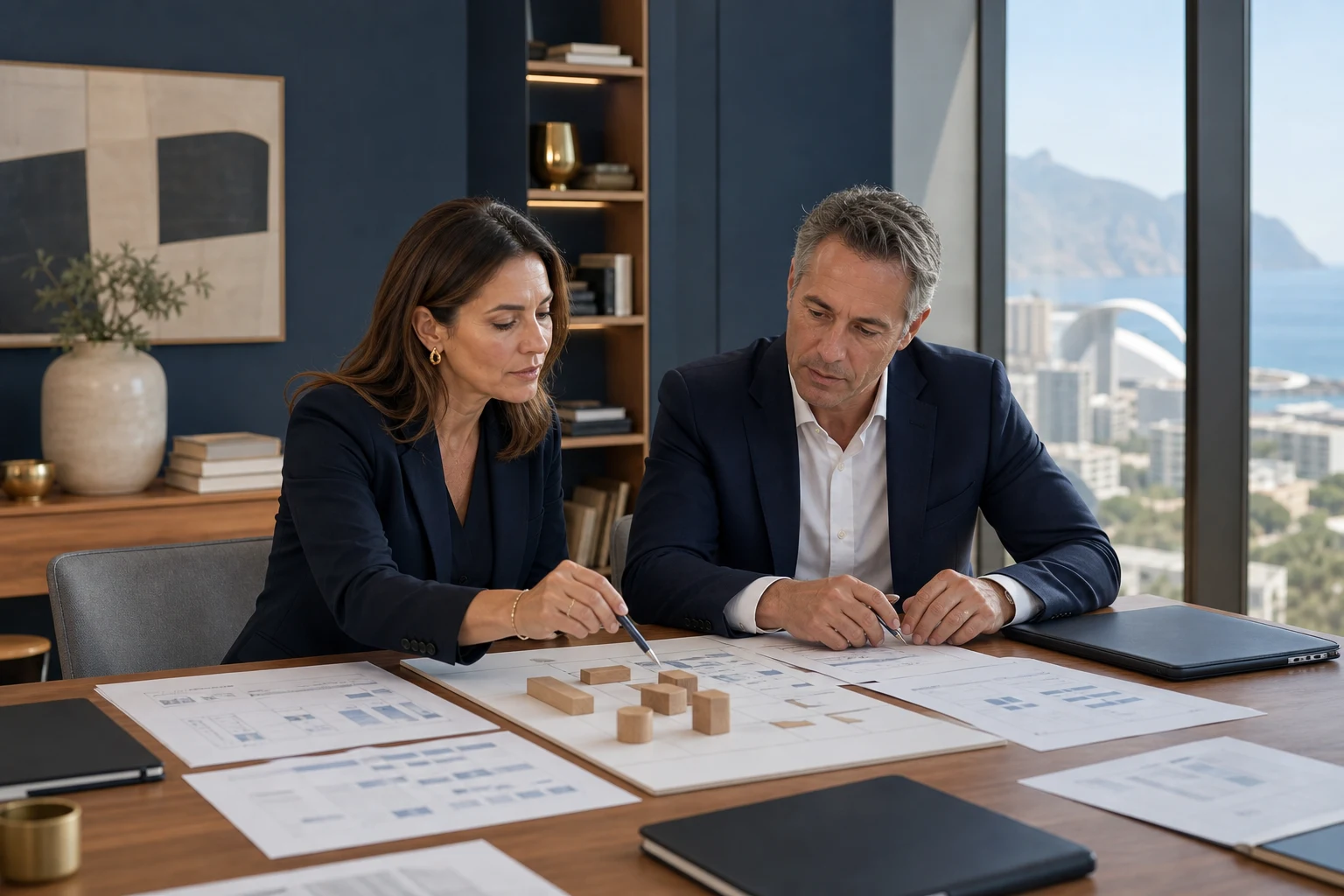
The problem is not always workload
Is your business growing while everything still depends on you?
Many businesses do not have a sales or effort problem. They have a structure problem. Activity grows, new people and clients arrive and more tools are introduced, yet work still depends on informal instructions, knowledge held by a few people and decisions that always return to management.
- It is unclear who owns each task and who is accountable for the result.
- People duplicate work or assume that another team is responsible.
- Critical processes depend on undocumented knowledge.
- The same errors recur and their origin is difficult to trace.
- Information is scattered across email, messages, folders and spreadsheets.
- New employees take too long to understand how the business works.
- Departments operate with weak coordination and different criteria.
- New tools are introduced without improving day-to-day operations.
- Revenue grows, but disorder, interruptions and founder dependence grow too.
- Delegating feels like losing visibility and control.
A practical definition
What is Organisational Architecture?
It is the integrated design of how a business distributes functions, responsibilities, decisions, processes, information and controls. It is not simply an organisation chart: it defines how the company should work in practice.
A sound structure enables each area to understand what it must do, who is accountable, how work is performed, which information must be produced, who reviews the result and what happens when an issue occurs.
- Functions and responsibilities without grey areas.
- Defined decision levels and authority limits.
- Processes with a start, owner, controls and outcome.
- Useful information for coordination and supervision.
- Continuity and substitution arrangements for absences.
- Issue-management, review and escalation paths.
From diagnosis to implementation
What does Advixy do?
1. Organisational diagnosis
We examine how the business really operates: business model, structure, people, decisions, critical processes, communication, tools, documents, controls, recurring issues and bottlenecks.
2. Structure design
We define areas, hierarchical and functional relationships, reporting lines, decision levels, owners, coordination and the path from the current structure to the target structure.
3. Roles and accountabilities
We set out the purpose, functions, responsibilities, authority, decisions, inputs, expected outputs, reporting, coordination and cover arrangements for each role or area.
4. Process design and documentation
We organise processes such as client onboarding, proposals, contracting, purchasing, invoicing, collections, payments, document management, complaints, employee onboarding and management reporting.
5. Internal control and traceability
We design approvals, validations, evidence, review paths, indicators, calendars, escalation mechanisms and management dashboards.
6. Technology and automation
We determine what should be centralised, simplified, integrated, documented, measured, automated or removed. Technology follows the process, not the other way around.
7. Implementation and support
We support ownership assignment, phased implementation, tool adaptation, internal training, issue monitoring and subsequent adjustments.
Useful, proportionate deliverables
What does the business receive?
The scope is tailored to the organisation’s size, complexity and stage. We do not deliver generic manuals that nobody uses.
- Organisational diagnostic report.
- Map of problems, dependencies and risks.
- Current and target organisation charts.
- Map of areas, functions and responsibilities.
- Role or function profiles.
- Responsibility matrix.
- Process maps and operating procedures.
- Approval and validation workflows.
- Issue-management and escalation system.
- Indicators and management dashboards.
- Technology and automation requirements.
- Phased implementation plan.
- 30-, 60- and 90-day priorities.
- Support for management and the team.
An integrated business perspective
A structure connected to the whole business
Decisions about departments, hiring, outsourcing, invoicing, approvals or control systems may have financial, tax, employment, documentary and technological consequences. That is why we do not design the organisation in isolation.
- Strategy and operating model.
- Tax and accounting.
- Employment relations.
- Document control and compliance.
- Technology and automation.
- Internationalisation and local structures.
Where the service creates most value
Which businesses is it designed for?
Growing businesses
SMEs whose activity, team or client base has grown faster than their internal structure.
Founder-dependent companies
Organisations where too many decisions, relationships and pieces of knowledge remain concentrated in one person.
Professionalisation and succession
Family businesses preparing for a new stage, investment, expansion, succession or the appointment of new managers.
Teams with coordination problems
Companies with departments, entities, locations or external providers that lack shared responsibilities and workflows.
Digitalisation and automation
Businesses that want to organise a process before introducing tools, integrations or automations.
International projects
Businesses that need to coordinate a local structure with group management, processes and controls.
A method built for implementation
Our methodology
- Understand.
We learn the business, its goals, its team and how work is currently performed. - Diagnose.
We identify duplication, dependencies, risks, informal processes and loss of control. - Design.
We define the target structure, roles, processes, owners and monitoring mechanisms. - Implement.
We turn the design into priorities, ownership, tools and concrete actions. - Review.
We check operation, correct deviations and adapt the model as the business evolves.
Outcomes that guide the project
What outcomes do we work towards?
- Less dependence on senior management.
- Clearer roles and responsibilities.
- Delegation with visibility and control.
- Fewer errors and duplicated activities.
- More predictable processes.
- Better coordination between areas.
- Accessible, traceable information.
- Faster, more orderly onboarding.
- Better use of technology.
- Decisions based on reliable information.
- A structure ready for growth.
Strategy and execution in one team
Why Advixy?
A business cannot be organised by looking only at human resources. We connect organisational structure with the financial, tax, accounting, employment, documentary and technological workings of the company. We work alongside management to build an organisation that is realistic, applicable and aligned with strategy.
Spain 360° Consulting
A coordinated perspective on the business and its strategic decisions.
Technology consulting
Tools and integrations that support clearly defined processes.
Tax advisory for businesses
Tax and financial implications connected to real operations.
Advixy USA Desk
Market validation and operating structure for entering the United States from Europe.
Answers before you begin
Frequently asked questions about Organisational Architecture
Is Organisational Architecture just an organisation chart?
No. The chart is only a representation. The service also analyses roles, responsibilities, decisions, processes, controls, tools, information and coordination between areas.
Is this a human resources service?
Not exclusively. It may include role and responsibility design, but its scope is operational and business-wide: it considers how the whole company should be organised.
Do we need a large team?
No. A small business also needs clarity around roles, processes, external collaborators and responsibilities. Designing the structure before growth prevents later dependencies.
Can you help when everything depends on the founder?
Yes. We design a model that distributes responsibilities, establishes decision levels and maintains appropriate management oversight.
Does the service include process automation?
It may include identifying and designing automations. We first review and organise the process, then determine which tasks can be automated safely.
Do you provide internal procedures?
Yes, when they are part of the agreed scope. Procedures are based on actual operations and identify tasks, owners, controls and outcomes.
Do you help implement the new structure?
Yes. We can support management and the team during implementation, review issues, measure adoption and adjust the model.
How long does a project take?
It depends on the size of the business, the number of areas and the depth of analysis. After an initial meeting we define phases, scope, timetable and budget.
Advixy · Santa Cruz de Tenerife · By appointment
Your business should not depend on improvisation
If the business has grown but its structure has not evolved at the same pace, it is time to organise how decisions are made, how work is distributed and how execution is controlled.
Describe your company and its needs in the AdvixyOS form. Our team will review the information before defining the scope and quotation.
Advixy SL · Santa Cruz de Tenerife · Consultations by appointment only


